Linktree vs a real mini-site: why a list of links quietly loses you customers
The Carder Team · Jun 27, 2026
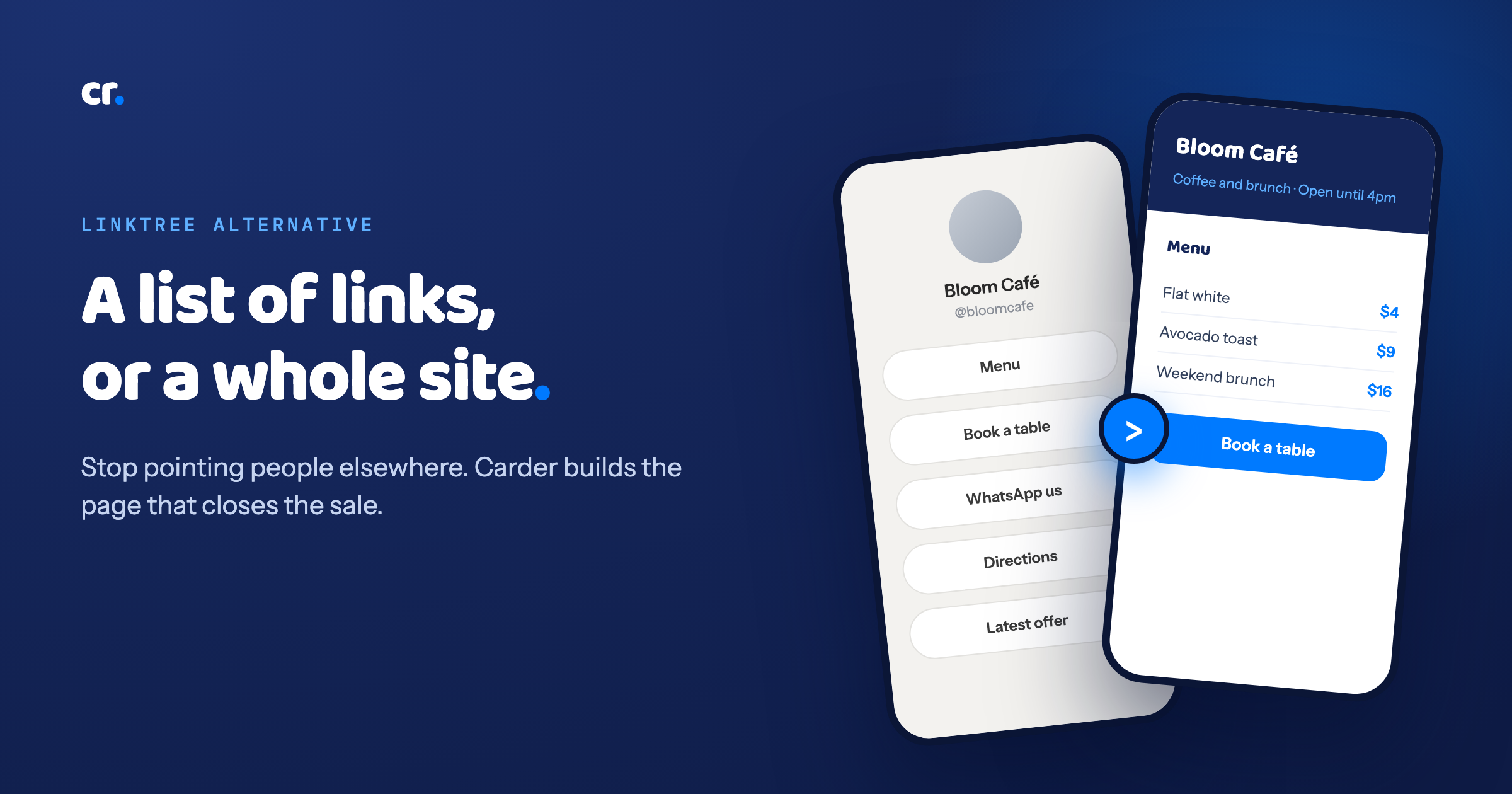
Linktree solved a real problem. Instagram gives you one link, you have five things to share, so you put a list of buttons behind that one link and you are done. Simple, free, everyone uses it.
Here is the catch nobody mentions. A list of buttons is a fork in the road. Every tap is a decision you are asking a stranger to make, and every decision is a chance for them to give up. You worked hard to get someone to your profile. The last thing you want at that moment is to hand them a menu of exits.
What a link list actually does
Think about what happens after someone taps your bio link.
They land on a page that is mostly your face and a stack of buttons. Menu. Book now. WhatsApp. Directions. Latest offer. They have to guess which one holds the thing they came for, tap it, wait for another page to load, and hope it was the right guess. If it was not, they go back and try again.
Most people do not go back. They came in warm and left cold, because you made them work for something you could have just shown them.
A link list is a signpost. It points at things. It never actually shows anyone anything or closes a single sale by itself.
What a mini-site does instead
A mini-site is the destination, not the signpost. The menu is right there. The prices are right there. The booking button, the hours, the location, all on one page, no guessing and no second load.
For a café that means the full menu with prices instead of a link that opens a blurry PDF. For a barber it means a booking section and a price list on the same screen. For a freelancer it means your services and a way to get in touch without a detour through three other apps.
Same single link in your bio. Completely different outcome, because the page does the work instead of delegating it.
When Linktree is genuinely fine
Let us be fair. If you are a creator whose whole job is sending people elsewhere, to a YouTube video, a Spotify track, a Patreon, then a list of outbound links is exactly right. That is the job. Linktree is built for it and it is good at it.
The mismatch shows up when you are a business or a professional. You do not want to send people away. You want them to see your menu, book the table, buy the thing, walk through your door. A list of exits is the wrong shape for that, no matter how tidy it looks.
What to look for in a Linktree alternative
If you run a business, judge the alternatives on this, not on how many link buttons they support:
- It answers, it does not just route. Menu, prices, hours and services on the page itself.
- It sets up fast. You should not spend an evening adding links one by one.
- It handles a menu without you retyping it every time a price changes.
- It takes bookings or orders through the channels you already use.
- It speaks your customers' language, including proper Arabic right-to-left layout when you need it.
The part that used to be hard
The reason people reach for a link list is not that they prefer it. It is that a real site felt like a project. A designer, a template to wrestle, a weekend gone.
That is the part that changed. Carder builds the mini-site for you from one sentence about your business, or from a screenshot of your Instagram profile, in about 30 seconds. The AI picks the right sections, writes a first draft, and assembles the whole thing. Everything it makes is yours to edit, so you get a real page without the weekend.
Here is what that page gives you that a link list cannot:
- A complete mini-site, menu, prices, hours and booking, behind one link and one QR code.
- Menu OCR: photograph a paper menu and Carder turns it into a browsable menu page (Business plan).
- Arabic sites generated in proper right-to-left layout, not a translated afterthought.
- Booking and forms built in on Pro and up.
- Print-ready QR codes, with a logo embed on Business, for tables, counters and flyers.
- A free plan to publish a real page, then Pro at $12/mo and Business at $29/mo as you grow.
A links section is one of Carder's core sections too, so a simple link page is still a valid Carder site. The difference is you can grow it into a real site later without ever changing the link in your bio. See the full side-by-side on Carder vs Linktree.
Other alternatives worth knowing
To keep this honest rather than one-sided, here are the other names you will run into:
- Beacons is a creator link-in-bio with a store and media kit. Strong for monetizing an audience, less so for a local business. See Carder vs Beacons.
- Carrd builds neat one-page sites, but you build every element by hand and there are no business sections or menus.
- Taplink offers block-based landing pages with payments, if in-page checkout is your priority today. See Carder vs Taplink.
- Durable bundles a website with CRM and invoicing, heavier than a bio-link site. See Carder vs Durable.
The right pick depends on the job. For pure routing to platforms you already run, Linktree. For a hand-built landing page at the lowest price, Carrd. For a business that needs its bio link to become a real site in thirty seconds, Carder.
How to switch in ten minutes
- Describe your business in one sentence, or upload a screenshot, and let Carder generate your site.
- Fix anything that needs it. Most people publish within minutes.
- Swap the link in your Instagram and WhatsApp bio.
- Keep your Linktree up until you are happy. There is no downtime.
Frequently asked questions
Is Carder free like Linktree? Both have a free plan. Carder's free plan publishes a real one-page site with an automatic address. Paid plans start at $12/mo (Pro).
I only need a few links. Is Carder overkill? No. A links section is one of Carder's core sections, so a simple link page is a valid Carder site. You just get room to grow into a real site later, using the same link.
Can I keep my Linktree while I try Carder? Yes. Generate your Carder site, swap the link in your bio, and delete Linktree whenever you are ready. Nothing breaks in between.
Does Carder support Arabic? Yes. Describe your business in Arabic and the AI generates your site in proper right-to-left layout, menus included.
A link list asks your customer to choose an exit. A mini-site answers their question and takes the booking. One of those grows a business.
If your bio link is a list of buttons right now, it is worth seeing the alternative. Generate your site, free. One sentence, about thirty seconds, and your bio finally points at something that closes the deal itself.